

TLDR;
- Analyze your cold call conversations at exhaustive scale.
- TitanX is now available in the HubSpot App Marketplace. [docs]
- TitanX Salesforce integration now enables dynamic list scoring. [docs]
- TitanX listed as top ten most purchased new SaaS of 2025
- Throwback: that time Vanta’s CRO gave us a shoutout in the wild.
News first, because it's genuinely great news: Vendr just published their 2025 year-in-review, and TitanX is on it: one of the top 10 most-purchased products introduced to their platform last year.
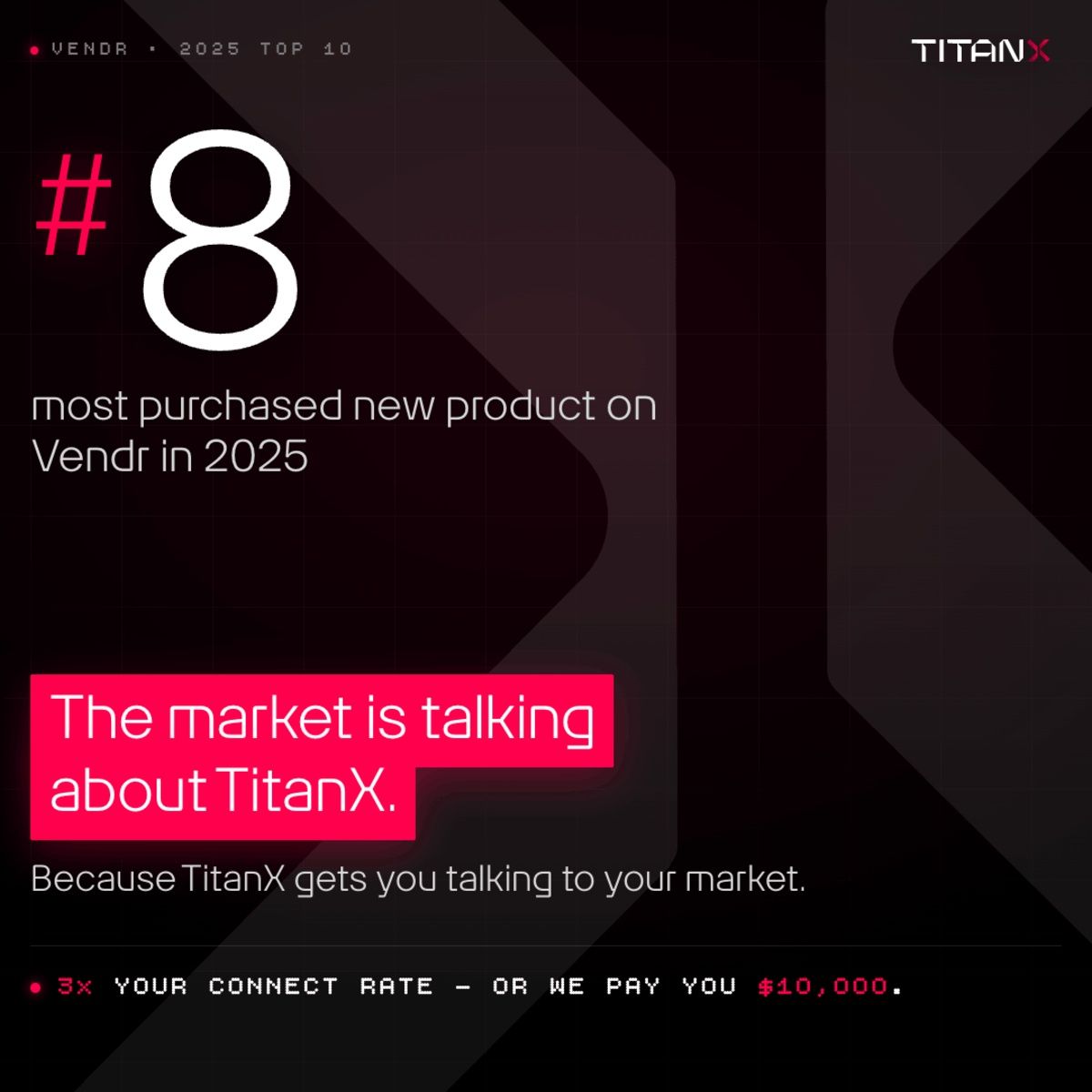
The SaaS buying market just told us something about TitanX. The market (via cold call conversations) has been telling us something for a year. Both matter. Only one of them we can actually analyze in depth.
For context: Vendr is a SaaS buying platform that helps finance and procurement teams negotiate software. When they cut a list of the most-purchased products introduced in a given year, they're not running a popularity contest, they're reporting transaction volume. Real contracts, real ACVs, real buyers who went through the work of pulling out a credit card.
It's a big list. Think: Vendr’s SaaS Rising Stars cohort. Last year's included Anthropic, Cursor, and Regal. This year we're on it.

Spot the newbie. Half those other folks are in our pipeline.
Thank you to every customer who put us there. Every buyer who fought for a line item. Every procurement team who processed a purchase order. We appreciate you.
Now here's the thing I want to talk about, because it's the kind of moment that's easy to get wrong.
Two kinds of market signal
When a list like Vendr's drops, it's tempting to treat it as the signal. The market has spoken. We are validated. Print the t-shirts.
But Vendr is telling us what the market bought. That's a proxy. A really good proxy (one of the best available in SaaS) but it's downstream of everything interesting. By the time a company shows up in Vendr's data, the evaluation is done, the POC is done, the contract is negotiated, the CFO signed it. All the reasons why are long over.
It's fan mail, in other words. And fan mail is not research.
The thing Vendr can tell me: that people bought TitanX.
The thing Vendr cannot tell me: why a CRO at a 2,000-person SaaS company three weeks ago said, on a cold call, "We had a parallel dialer for a year and shut it down for all the reasons you probably don't like it." Or why, on a different cold call, a BDR leader told us he'd rather not know his connect rate because "it'll just depress me." Or why the discussion of “hiring SDRs” showed up in almost 1% of calls in H1 2025, and 0% 2026 year-to-date.
Those are not transactions. Those are conversations. And they are the other kind of market signal.
What we actually did with a year of quality conversations
In the last newsletter I shared that we pulled 3,541 cold call transcripts from our own outbound motion and read them as market research. 198 hours of live human conversation.
Here's a short version of what we found that we did not know before:
- Nobody is hiring SDRs. We had 0.7% of H1 2025 calls mention headcount growth on SDR teams. In H1 2026 that number is zero. Not "lower." Zero.
- "Timing" is the objection we lose to, not "product." "Call me back later" + "send me an email" + "not a good time" together account for ~29% of the initial responses on our calls. "Already have a solution" accounts for 5.8%.
- Parallel dialers are losing their shine. Parallel dialer mentions dropped from 5.2% of calls in Q2 2025 to 1.1% in Q1 2026. That's a contract cycle. That's a product opportunity. That's a timing signal a Vendr list will not give you for another 12 months.
You don't get any of that from Vendr. You don't get any of that from a customer advisory board. You don't get any of that from your demo call recordings, because everyone on a demo call has already decided we're worth 30 minutes.
You get it from cold calls.
Why we're going to keep having conversations
We are (genuinely) thrilled about the Vendr listing. It is a meaningful external validator, and we'd be fibbing if we said otherwise.
But it doesn't change the thing that got us there. What got us there was conversations. With customers. With prospects. With people who had never heard of TitanX and picked up anyway. With people who picked up and told us they don't do outbound. With people who picked up and told us they wish they were doing more outbound. With the 85% of our TAM that Vendr has, by definition, no data on, because they haven't bought anything yet.
The thesis we’ve been beating the drum on is that conversations are the atomic unit of GTM. Not meetings. Not pipeline. Not logos on a website. Conversations. The live, two-way, one-human-to-another kind. The ones that tell you what the market actually believes about itself, its tools, its competitors, and its future.
A Vendr listing tells us what the market did. A year of cold call transcripts tells us what the market thinks. We are going to keep gathering both, and we are going to keep reading the second one like our strategy depends on it.
Because it does.
One thing to take from this, if you're running a GTM org
You probably have a Gong or a Salesloft or a dialer somewhere full of cold call recordings you've never analyzed in aggregate. You're measuring them by dispositions and meetings booked. If that's all you're doing with them, you are leaving the single highest-leverage research dataset your company has sitting on the shelf.
Pull 90 days of transcripts. Run three analyses:
- Objection patterns. What are prospects actually saying "no" about?
- Competitor mentions. Who's coming up unsolicited vs. who are you bringing up yourself?
- Rep talk share by disposition. Are your wins and losses correlated with how much your reps are talking?
You will find something. You will find several somethings. And then (if you're lucky, and you keep listening) eighteen months from now a list like Vendr's will print your name, and you'll know exactly why.
Thanks for reading. And thanks for the Vendr nod. We're celebrating by making more calls.
Evan Dunn (LinkedIn)
P.S. If you read this far, you probably want more conversations. Reply to this email.

Staunch advocate for conversation-led growth, known for bringing scientific rigor to go-to-market models.

.svg)
.svg)
Continue Reading

Workslop ate 10% of your pipeline

Stop practicing bloodletting on your SDR org

Empire of the Inauthentic