

A prospect told us proudly last week they had a "high" connect rate of 11%. They even shared a screenshot of data from their power dialer confirming it:
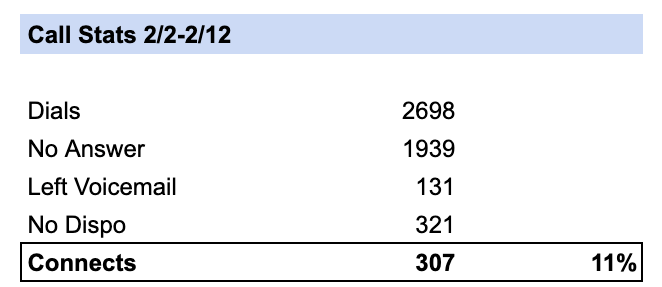
But then… what’s this?
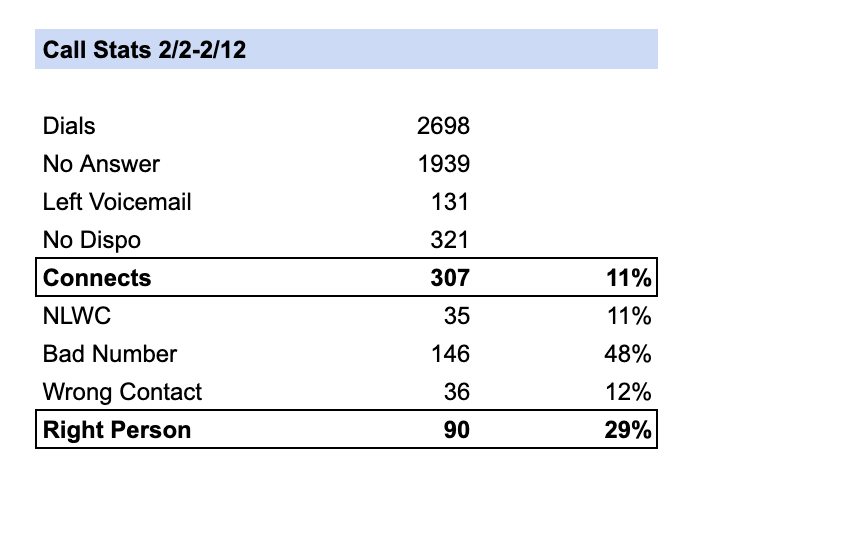
Only 90 of the connects they thought they had were actually the person they needed. The real connect rate is 3.3%.
Pikachu hurt itself in its confusion.
It’s not a connect if the person you connect with isn’t the connection you wanted.
There’s something that happens when people think about how to cold call where critical thinking and skepticism take a back seat. Maybe it’s because people think the phone is so fundamental to society as a public utility that it’s sort of monolithic and un-optimizable. Or they think of it as so legacy that it can’t be gamed (for good or bad).
But if you’re using a power dialer (good) or a parallel dialer (bad), you should know that your vendor of choice doesn’t share in your illusion.
They are very much in on the game of juicing up your numbers to make themselves look good, and they’re aware that the performance data they provide you (look at all those connects!) is suspect.
So un-suspend your skepticism and start asking some tough questions:
- How do you define a "connect"?
- What's the minimum call duration that counts?
- What's the sample size?
- Who are you targeting? 11% might be a strong connect rate for some audiences. Could be middling-to-poor for others (I see you, EMEA callers).
- How many of those "connects" turn out to be wrong contacts or bad numbers?
- Do you capture a real disposition on every connect?
If your outbound strategy, your vendor decisions, and your headcount plan are built on a connect rate that doesn’t hold up after you ask those six questions, the foundation is cracked.
"Connect" is an undefined term
You might think you share a definition with your vendor, your Ops team, your boss, your reps. You’d probably be wrong.
Especially since not even every vendor can agree on what a “connect” really is.
Orum says you’ve connected if you speak with the intended prospect. They call it a conversation if it lasts more than 60 seconds.
Nooks says… actually, we scoured Nooks’ documentation and couldn’t find a publicly shared definition of a connect. So. (We did find a blog! see below)
Depending on your vendor, a wrong number counts. A gatekeeper who says "he's not available" counts. A voicemail counts. A prospect who answers, says “hello”, hears dead-air from a parallel dialer, says “anybody there?” and hangs up in confusion counts.
The TitanX gold-standard definition of connect rate:
❝
connect rate \kə-ˈnekt ˌrāt\ n.
in cold calling: a conversation, of any length, with the actual person targeted — distinguished from voicemails, gatekeepers, or wrong contacts.
That’s a much higher standard. But it should be: after all, a connect “is what you pay your reps for: conversations with the people you’re having them call.” - Reese Kerlin
“A connect is when you get the person you intended to speak with to pick up on the other line.” - Cathy Park
Real SDRs.
Those two SDRs consistently hit 20-30% connect rates.
Real connect rates.
The fact that there’s such a variety here makes it crazy that nobody audits the numerator. They just assume they’re getting all the connect rate they can, and push for a bigger denominator: more call volume.
A connect is not a conversation
Even if you clean the definition so you only count right person, right number, and they pick up, you still don't have what you ultimately need. You have a pickup. Someone said "hello." That's not an at-bat. That's not a real conversation.
It produces no pipeline intelligence, no disposition, no usable signal for follow-up.
We distinguish between connect rate and conversation rate in our own models, and we do it for our customers too.
A "conversation" means enough two-way talk time to qualify, disqualify, or gather account intelligence. It means the rep got a disposition they can act on. Even if the outcome is "not now," that's a signal worth capturing. It feeds call science, triggers marketing nurture, informs the next dial or campaign.
The conversation is the atomic unit of a sale. The connect isn't.
This is why you must review your connect rates: if these suffer, conversations suffer, which means pipe gen and your ability to optimize it suffers.
Your vendor has no incentive to fix this
Dialer vendors report connect rates as their primary proof point. It's the number in every case study, every sales deck, every G2 review.
Ask yourself: does your vendor benefit from a tighter definition?
They don't.
And because the vendor controls the reporting, you're trusting the party with the most to gain from inflation to give you the real number.
You shouldn't.
By the way - not even us. We’re not so bold as to ask for your blind trust. We ask for the opportunity to give you irrefutable proof we have the best solution.
You can't be an excellent GTM operator – whether you're a CRO, a sales leader, or in revenue operations – if you aren't constantly skeptical of the metrics you're given. Especially when the party reporting them has a financial interest in making them look good.
In a blog titled “Top Dialer Metrics that Predict Pipeline Growth” you can see this false incentive play out on Nooks’ website. While they say the very true thing that
"Connect rate is the heartbeat of outbound. Every other metric flows from it. If reps aren't connecting, they aren't learning, testing talk tracks, or booking meetings."
They also claim that connect rate is the “percentage of outbound calls that reach a real human."
Not the intended human. Any human.
Both cannot be true: either connect rate is based on the intended prospect, or it is not the heartbeat of outbound.
How to audit your real connect rate
So how do you get to the truth?
- Define "connect" narrowly: a pickup by the intended prospect where they say something to you. Leave a disposition of “Connect Incomplete” available if the conversation gets cut off or they hang up before the conversation begins.
- Filter lists aggressively. Strip out wrong contacts, bad numbers, and gatekeepers. If you think volume or “more AI” will save you from a messy list, you’ve got an uphill battle. Here’s how you should build your list, by the way.
- Track dispositions. Meeting booked, callback requested, not interested, wrong timing, referred to someone else. Even a "no" is a signal. A connect without a disposition is a wasted data point. (Joey wrote about Disposition Science – worth reading if this is new to you.)
- Separate "connect rate" from "conversation rate" in your reporting. Report on both. We use “completion rate” to indicate when we go from a connect to a full run through the script. Many great callers also use a conversation metric with a minimum duration threshold of 60 seconds or similar.
- Score your lists before dialing. Use TitanX Phone Intent™ data to identify which contacts are behaviorally likely to answer a cold call, so every dial targets the reachable ~20% of your market. This alone broadens the biggest bottleneck on your cold-call production pipeline (dial:connect ratio).
- Benchmark against outcomes, not activity. Meetings booked per 100 dials. Opportunities created per rep per week. Pipeline dollars per conversation.
The metric you report is the strategy you get
If you report an inflated connect rate, you get an inflated sense of health. You defend the current vendor. You keep the current playbook. You tell the CFO the outbound motion is working when it's producing 3.3% real connects dressed up as 11%.
Might look like an 8% miss, but it’s really more like a 333% inflation. It’s big.
And when you miss a target this quarter, you have no structural explanation because the foundational metric was never interrogated.
Don’t put yourself in that situation. Measure the right stuff.
An inflated connect rate justifies more dials, more reps, more volume.
Reporting on connect rate in a way that distinguishes between a pickup and a conversation, between a wrong number and a qualified at-bat demands precision.
Thanks for reading,
Evan Dunn (LinkedIn)
P.S. Run the six-question audit on your own connect rate this week and hit reply with what you find. I read every response.

Staunch advocate for conversation-led growth, known for bringing scientific rigor to go-to-market models.

.svg)
.svg)
Continue Reading

Workslop ate 10% of your pipeline

Stop practicing bloodletting on your SDR org

Empire of the Inauthentic